What Can Go Wrong
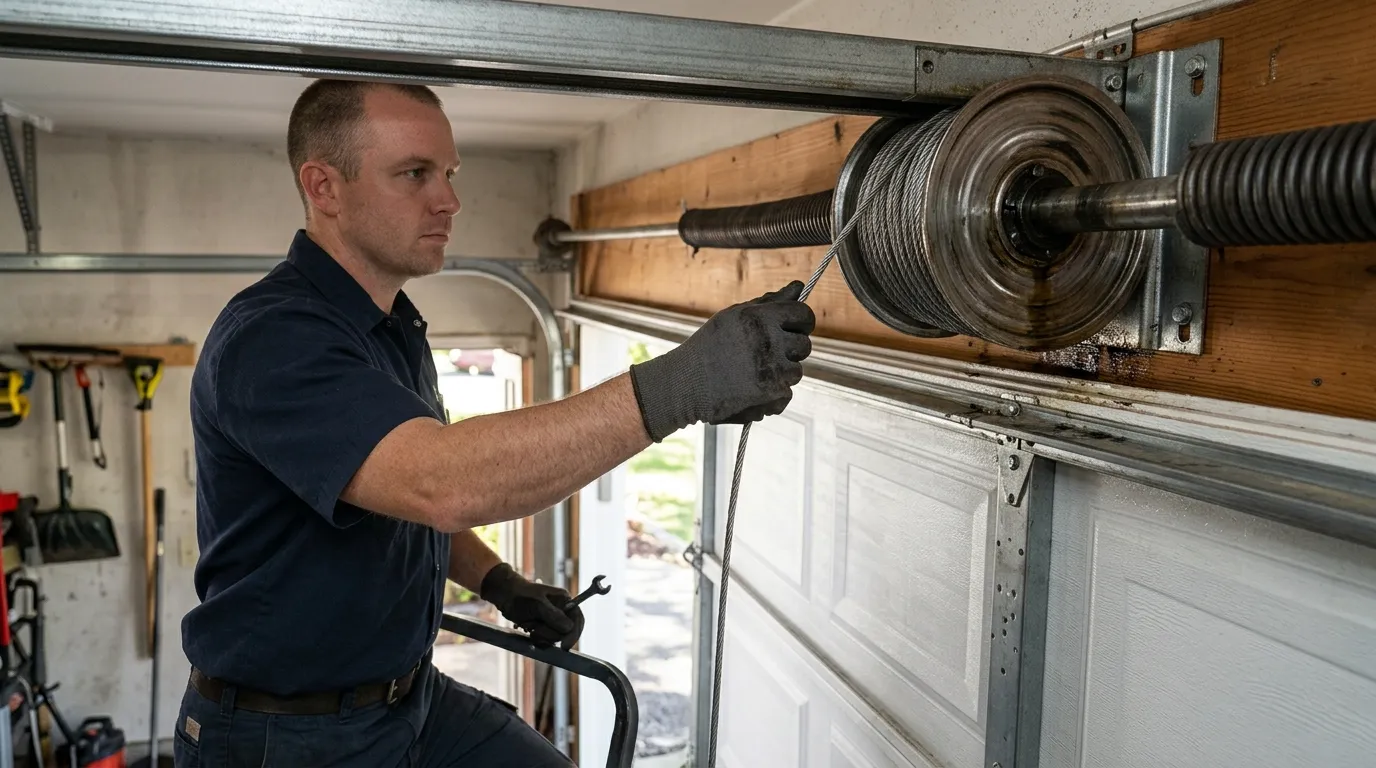
Grafton's median home dates to 1986, which puts most of the neighborhood well past the older extension-spring era. What you've got instead are steel sectional doors, usually 16 feet wide for a double bay, hung on torsion springs mounted on a shaft above the opening. That's a heavier door than the plank-and-panel doors you'll find in older housing, and it runs on hardware that was built to a different standard.
The failures we see out here track that. Torsion springs on a wider door carry more load, so when one goes, it goes hard - the door won't budge, or it slams down uneven because only one side let go. Openers from the late 80s and 90s chain-drive units are also aging into their second or third capacitor and gear-drive failure, and a lot of them were never swapped for anything with rolling-code safety reversal. Rollers on steel doors from this build era are usually stamped steel, not nylon, and they wear grooves into the track over fifteen or twenty years of daily use that eventually bind the whole door.
We don't guess at this from a truck full of generic parts - a 16-foot torsion door takes different spring wire, different drums, and different cable length than the 8 or 9-foot single-car doors you'd find on an older infill lot.
The Symptom
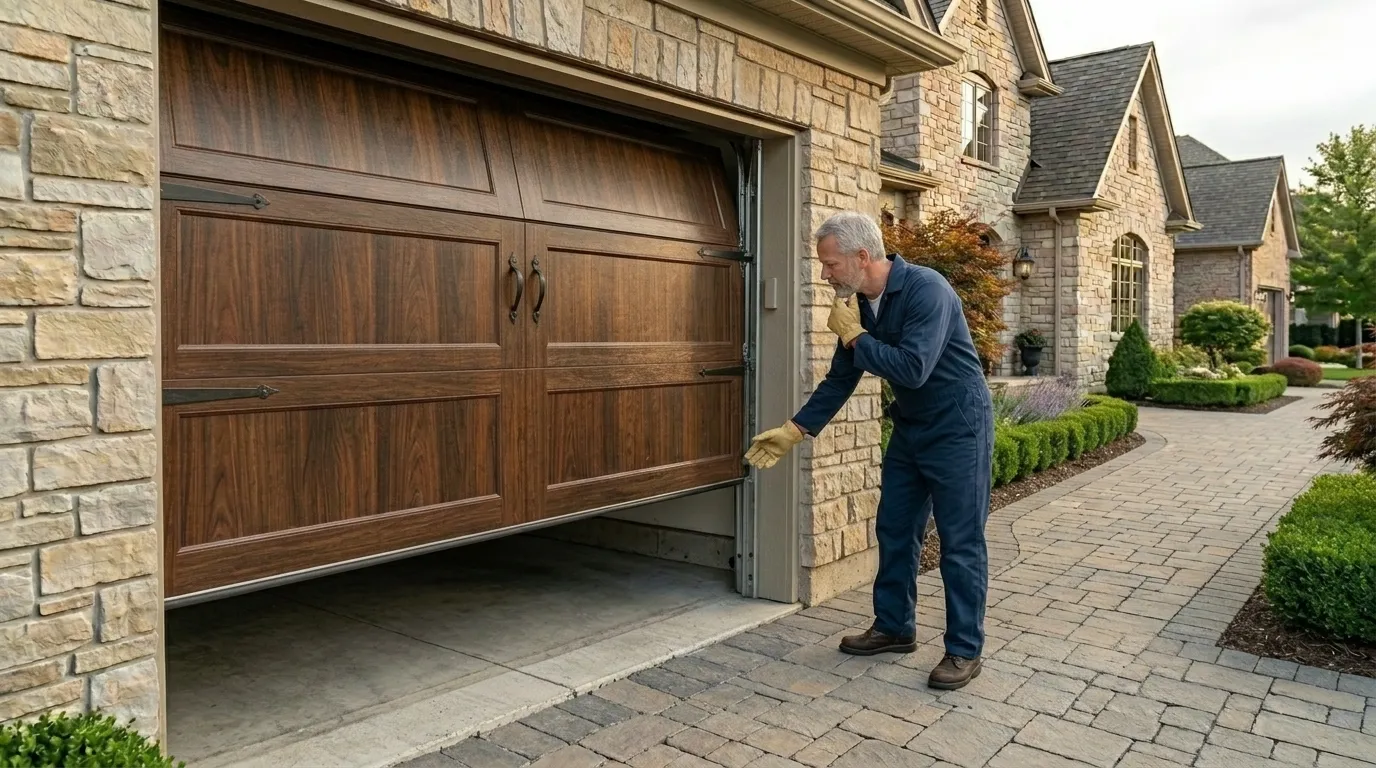
The complaint we hear most from this side of the service area is a door that moves a few inches and stops, or one that comes down crooked and jams in the track about halfway. Both point to a torsion spring that's lost tension unevenly - one side still has some wind left in it, the other doesn't, and the opener isn't strong enough to fight a door that's now leaning on the tracks. Homeowners often try the wall button a few more times, which just stresses the opener's gears trying to lift a load it wasn't built to carry alone.
A second common call is a door that reverses on its own a foot from the floor. On these builds that's usually a worn roller riding low in a track that's slightly bent from years of use, tripping the opener's safety sensor logic. It's not a broken part so much as a tolerance that's drifted past what the opener will accept.
Less often, it's a cable that's frayed at the drum - visible if you look, dangerous if you don't and it lets go under full spring tension.
Why This Fails Locally
Grafton sits in a cold-climate zone with severe winter conditions, and that matters more for a wide double-car door than a narrow one - more steel surface means more contraction in a hard freeze, and torsion springs lose a little tension in deep cold right when the door is heaviest to lift by hand. On a 16-foot door that difference is the gap between an opener that struggles and one that stalls.
We cover Grafton from West Bend, 14 miles out, which is close enough that a same-day torsion spring job is realistic once we've got the right spring on the truck for a door this size - we just don't carry every wind length for every door built between 1958 and 1999 on every run.
With roughly 5,612 households in Grafton and a median income of $88,634, most of what we see here is people choosing a proper spring or track repair over letting a cheap fix fail twice - the math on doing it right once tends to work out at that income level.
Stocked Parts
We keep common torsion spring sizes for 16-foot double doors on the truck, since that's the width you'll mostly find on Grafton's post-1986 builds, along with standard-length lift cables and steel rollers to match. Track sections we carry in the lengths that fit an 8-foot standard door height, which covers most of what's out here.
What we don't stock cold is opener circuit boards for older chain-drive units - those are often special-order once a manufacturer stops making them, and we'll tell you upfront if that's the case rather than have you wait on a part that isn't coming. In that situation, a new opener is usually the faster and cheaper path anyway.