The Problem
Most houses in this part of Washington County went up between 1958 and 1999, with the bulk of that stock dating to the 1960s and '70s. That matters because a door doesn't fail randomly - it fails the way its era fails. A door on original hardware from a 1968 build fails differently than one installed in a 2015 remodel. When you call about a noise, the first thing we ask is roughly when the house was built, because it tells us more than the sound does.
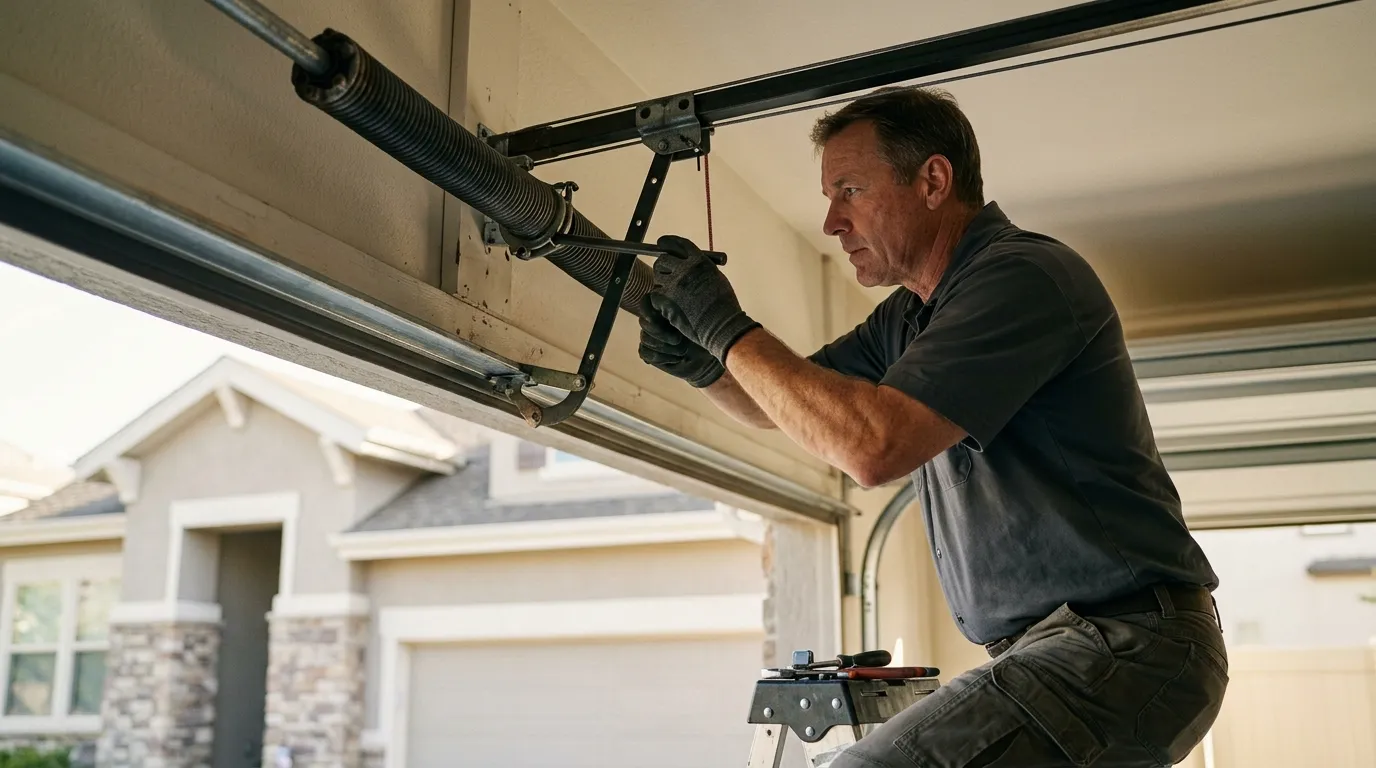
A grinding noise on a door from that older bracket of homes is usually a worn roller still riding in a track that was never resized when the roller wore. A rhythmic thump on the same house is often a spring that's lost tension unevenly - common on the older torsion setups that were standard through that build window. Newer installs in the area, going in on houses built closer to 1999, tend toward opener-related clicking rather than hardware failure, because the mechanical parts are younger even if the house isn't.
The noise itself is a symptom. What's underneath it depends heavily on what decade put that door in, and around here, that decade is very likely the 1960s or '70s.
The Common Mistake
The mistake we see most is spraying WD-40 on a squealing roller or hinge and calling it fixed. On a door that's been running on original 1960s-70s hardware, that's a temporary mask, not a repair - the noise usually comes back within weeks because the underlying wear (a track that's slightly bent, a roller shot through, a hinge pin worn oval) is still there.
The second mistake is homeowners tightening bolts on a door that's making a banging noise when the actual cause is spring imbalance. On the double-door setups common in houses from this era, an unbalanced spring puts uneven load on both sides of the track, and no amount of bolt-tightening fixes an imbalance in the springs pulling it.
We'd rather tell you this than sell you a service call: if your door is quiet 350 days a year and makes noise only on the coldest mornings, that's a lubrication and cold-stiffening issue, not a hardware failure, and it doesn't need a spring replacement. Not every noise is a big job. Some are a five-minute fix. We don't upsell people into repairs their door doesn't need, and we won't pretend every squeak is an emergency.
What the Weather Here Does to It
This area sits in a severe cold climate band, and that shows up in garage doors in a specific way: metal contracts, lubricant thickens, and springs that were already fatigued from age tend to announce it on the coldest mornings first. A spring that's fine at 50 degrees can bind or snap at 10 below, because cold steel has less give.
On the older housing stock common here - built mostly in the 1960s and '70s - the tracks were set up with looser tolerances than a modern install, so cold-weather contraction opens gaps that let rollers rattle in ways they wouldn't in July. If your door only makes noise in winter, that's the tell: it's a cold-stiffening issue on aging hardware, not a new mechanical failure.
We also see openers struggle to pull cold, stiff doors on severe winter mornings, which can sound like a motor problem when it's really a door that's harder to move because of the temperature, not a wiring issue. Winter doesn't cause damage on its own - it exposes wear that was already there.